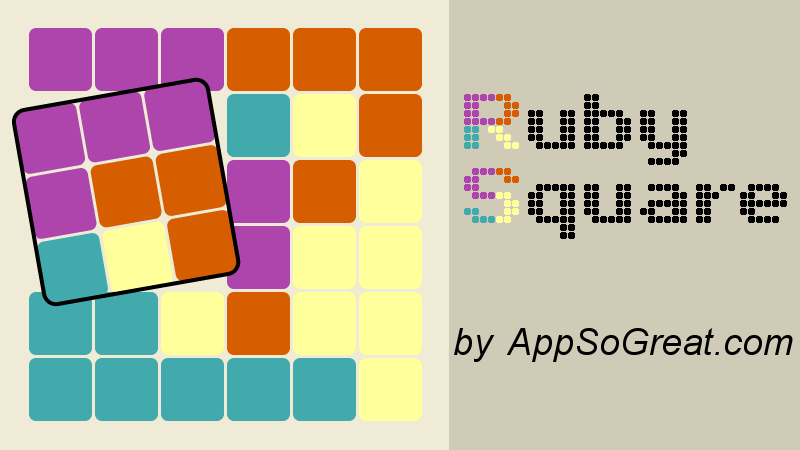
 RubySquare
The cross method
How top solvers read a board in one look.
Why some boards refuse to be solved in an even number of moves — and how to spot the impossibles before you burn twenty rotations chasing them.
Every Ruby Square board was generated by rotating away from a solved state — so every board is solvable. What's not guaranteed is how. Some boards are mathematically incapable of being solved in fewer than N rotations, and a surprising number of them have a parity quirk: they can't be solved in an even number of moves at all.
A 2x2 rotation is a permutation — it cycles four cells. In group-theory terms, that cycle can be decomposed into three swaps, making it an odd permutation. Rotating a 4x4 block cycles sixteen cells, which decomposes to fifteen swaps — also odd. Every legal move you can make is odd.
That single fact has a consequence: after an even number of moves, your board is in an even permutation state; after an odd number, odd. If the target arrangement is an odd permutation away from the current one, no even-length solution exists. None. You're chasing a ghost.
You don't need group theory mid-game — you need a heuristic. Count the cells that are out of place modulo the block cycle structure. On 2x2 boards: if exactly one or three blocks of four cells need attention in a single connected region, expect odd-length solutions. Budget accordingly.
World averages on Ruby Square are not minimums — they're medians of what real players did. The true minimum is usually 60–70% of that. Chasing it changes how you play: you stop solving forward and start solving backward, imagining the board un-rotating toward the target.
Backward thinking is the real parity trick. A board that's six moves deep scrambled forward is six moves deep unscrambled backward — but the backward path often reveals a shorter route the scramble didn't use.
Every move is an odd permutation — some boards mathematically cannot be solved in even moves.
Imagine un-rotating toward the target — the backward path often reveals a shorter route.
World average is a median of real play — the true minimum is usually 30–40% lower.
Guest contributor — combinatorics researcher
Tomas studies permutation groups at TU Eindhoven and consults on Ruby Square's board generator. He solves with a spreadsheet open.